jueves, 21 de julio de 2011

Forex - FX Market Commentary – July 2011

Euro weakness persisted last week with Friday’s better-than-expected banking stress test results only momentarily helping its fortunes. Only eight out the ninety banks tested failed the tests which are designed to gauge the health of the financial system in the event of an economic meltdown. Nevertheless, the news brought little solace to the broader market place with many questions just how ‘stressful’ these test actually are. The European Banking Authority priced the total shortfall of 2.5bn-Euros – however credit Suisse were quick to point out their belief the actual shortfall is actually 18 times greater than the EBA’s estimates requiring an additional 45bn-Euros with 14 banks deserving of the failed stamp.
The Euro lost near to 0.8 percent over the week against the greenback, but the real story can be seen by looking at its performance against the perceived safety of the franc. The Swiss franc continues to strengthen against the greenback with the EURCHF pair falling to another all-time low last week of CHF 1.1492 and falling even further in early trade to fresh all-time lows of 1.1375.
Likewise the US dollar also forged a new all-time lows against the Swiss franc this morning falling to lows of 0.8046.
The incessant rise of the Swiss franc has Swiss National Bank watchers on alert as the bank continues to express concern over its unprecedented appeal as a safety play. The persistence of the Euro-American debt concerns further increase the likelihood of Swiss franc strength, thus fueling speculation the SNB may impose capital controls to stem the rising currency. Of course another possibility is government relief directly to exporters or direct currency intervention. The latter would not be the favored option considering the losses sustained by the SNB as a result of directly intervening in the currency market. The central banks attempts to halt the strengthening currency lost CHF14bn in the first half of 2010.
We only need to look to the unrelenting rise of the Japanese Yen for clues in the sustainability of direct intervention.In response to the horrific events in Japan earlier this year – the G7 jointly intervened to stem the Yen’s advance. The threat of large scale repatriation of capital was enough to induce G7 nations to conduct joint intervention – but the action failed to have a sustained impact. These safe haven attributes have once again seen the JPY strengthen against its major rivals most notably making a convincing break to the downside of the ¥80 to the US dollar.
Like its neighbour across the Atlantic, the US is not without its potential pit falls. From debt ceiling woes to QE3 conjecture, there’s a veritable treasure trove of themes that could further devalue the greenback in the week ahead. Further complicating the US dollar matrix is the strengthening argument inflation is beginning to take hold - with Friday’s CPI numbers showing core inflation which excludes food and energy rose 0.3 percent in June. Although headline inflation declined 0.2 percent, (attributed to a drop in energy prices) core inflation rose at an annual pace of 1.6 percent once step closer to the Fed’s target of close to but below the 2 percent level. Headline inflation grew at an annual pace of 3.6 percent. The university of Michigan consumer confidence data sank below expectations to record a drop to 63.8 in June from a previous 71.5. Economists had tipped a rise to 72.2.
Considering this inherent lack of faith in fiat currency, it’s no coincidence the price of gold continues to forge new all-time highs. Last week spot Gold rose to highs of $US1,595.00 a troy ounce and has kicked off the week in spectacular style making new highs of $US1,599.00 a troy ounce.
It’s a fairly light week for economic data in the US this week with feedback on the housing sector the primary focus. The local week ahead will also be light on economic directives with the exception of to the RBA minutes for July, which will no doubt keep interest rate talk in the headlines.
We have another European summit coming up on Thursday which is expected to provide an understanding on how Greece’s custodians plan to structure a second round of financial assistance. Whatever the summit may bring, time is running out – the threat of contagion has amplified and threatens to spread to the heart of Euro-zone.

Source: http://www.forextv.com

FX Market Commentary – July 2011

Despite moderate Euro strength overnight the appeal of the Aussie dollar remained subdued with price action capped in a tight range below 107.5 US cents. With US markets closed for Independence Day, a decline in market participants made for light volumes resulting in general risk-neutral environment which provided little impetus to resurrect the Aussie following yesterday's slide in the domestic session.

Late yesterday the Aussie came under pressure alongside the Euro after ratings agency Standard and Poor's warned an extension of debt maturities held by private investors - although voluntary - may still warrant a 'selective default' rating. The Euro recovered after briefly slipping back through US$1.45 levels yesterday and maintained a slow upward trajectory overnight despite S&P's warning. The forthcoming rates decision, which is expected to see the ECB increase rates to 1.5 percent, gave participants a welcome distraction from the threat of default. Nevertheless, one can expect this threat to rare up again given the shock waves it would send through global markets. The European Central Bank has said they will not accept Greek debt as collateral in the event of a default rating. According to an article in the financial times citing a senior official, the ECB will continue to accept Greek debt as collateral unless all three major ratings agencies declare Greece to be in default.


The primary risk event for the local unit today will be the RBA interest rate decision due for release at 14.30 AEST. Although the decision will almost certainly see the RBA remain on hold at 4.75 percent, the usual post decision conjecture should prove to induce movement on the local unit as participants look to clues into the RBA's next move. Nevertheless, with much of the RBA's lukewarm rates outlook well and truly priced in the market, we expect the primary directive for the Aussie dollar to remain at the mercy of global risk trends. Earlier today we have the trade balance for May and HSBC Chinese PMI (Services) due for release. At the time of writing the Aussie dollar is buying 107.4 US cents.

Source: http://www.ibtimes.com

miércoles, 22 de junio de 2011

British Pound Tumbles on BoE Minutes Consideration of More Stimulus

If expectations for the Fed’s monetary policy decision were low, the prospects for the Band of England’s minutes were non-existent. However, it is when the entire market is caught off-guard that we see the biggest market reactions. In the wrap up to the central bank’s last rate decision, we found a few surprises that were influential enough to send the British pound tumbling. Adding a notable dovish twist to speculators’ already fading hopes for a rate hike sometime this year, the statement noted that some members felt that is was possible that “further asset purchases” may need to be made in the future if conditions warrant. This is far from a commitment; but set against slowing growth, challenges from the EU periphery and downplaying inflation pressures, it douses lingering speculation. We need to keep an eye on market rates to see if they ease.

FOREX: Dollar Climbs, S&P 500 Stumbles after Fed Offers No QE3 Security

FOREX: Dollar Climbs, S&P 500 Stumbles after Fed Offers No QE3 Security

  • Dollar Climbs, S&P 500 Stumbles after Fed Offers No QE3 Security
  • British Pound Tumbles on BoE Minutes Consideration of More Stimulus
  • Euro and European Yields Quickly Lose Confidence after Greece Vote
  • Canadian Dollar Wavers with Fed Festivities, BoC Warns of Rising Financial Risk
  • Japanese Yen and Nikkei Futures Steady through 6.7 Earthquake
  • Australian Dollar Finds More Guidance in Equities than Leading Index Release
  • Gold Briefly Rallies to Six-Week High before Fed Saps Inflation, Stimulus Influence
Dollar Climbs, S&P 500 Stumbles after Fed Offers No QE3 Security
It was the dollar’s turn Wednesday to steal the fundamental headlines. However, after the disappointing reaction to the Greek confidence vote (a vote that kept the administration in place and thereby supports the bailout initiative and the euro); Forex traders were more reserved in their expectations to the FOMC rate decision. The gravity of the event however was not lost on the market; and traders showed their appreciation for its influence by holding steady on most fronts until the announcement and commentary was crossing the newswires. After the data was fully disseminated and speculators had accounted for the adjustments it made to the markets’ future; a measured decline in risk positioning and climb in the dollar began. Through the opening half of the Asian trading session, we find S&P 500 futures down 1.5 percent from the previous session’s highs while the Dow Jones FXCM Dollar Index has advanced as much as 0.9 percent to 9,661.
Looking at the progress from the markets after the Federal Reserve announced its policy decisions and projections; it is clear that there were no exceptional surprises. That said, there was enough there to alter the outlook for monetary policy expectations and risk trends. With EURUSD retreating back below 1.4300 and GBPUSD slipping below the floor of a five-month rising trend channel, this is not an idle correction. Evaluating the events of the active afternoon New York session, no one was caught off guard by the decision to maintain the benchmark lending rate unchanged at its range between zero and 0.25 percent. The statement was similarly lacking for notable changes beyond a mention of the economic impact Japan’s natural disaster back in March has had. Things get interesting though with the updated economic forecasts. Dampening any lingering hopes that a rate hike could still come before the year is out, the group lowered its growth forecasts through 2013 and softened its near-term inflation outlook. For 2011, the central bank predicts expansion of 2.7 to 2.9 percent (from April’s 3.1 to 3.3) while PCE inflation was set to a 2.3 to 2.5 percent range (from 2.1 to 2.8 percent previously).
Tempering already anemic rate expectations should actually deliver a slight boost to risk and hit to the greenback. Instead, we are responding to the far more contentious scenario for a withdrawal of the extraordinary stimulus that has been pumped in the system, lowered US rates to near-record low levels and subsequently leveled the dollar. In the press conference that followed the decision, Chairman Bernanke reiterated the $600 billion QE2 program would expire at the end of the month. And, while he left the door open for future accommodation “if warranted”, such flexibility to is to be expected. The level of stimulus now looks like it will be held steady for a number of months while the central bank assess, the financial and economic stability. When the market starts speculating on its unwinding, we’ll see risk fall while rates and the dollar surge.
Source: www.dailyfx.com 

lunes, 16 de mayo de 2011

Forex trading: Did US Special Forces just rescue the dollar?

With the death of Osama bin Laden, U.S. forces ended a nearly 10-year worldwide hunt for the mastermind of the Sept. 11 attacks and boosted the U.S. dollar's reserve currency status, too, trader Steve Cortes said Wednesday.

"History shows us that the country with the strongest military is always the reserve currency," said Cortes, founder of Veracruz. "I think the ability of those heroes, of SEAL Team 6, to project power globally shows us that U.S. military is uncontested in its dominance and I think the currency will re-assert accordingly."

The dollar hit a three-year low against a basket of currencies on Wednesday, as the euro gained to nearly $1.50. Being as the dollar has taken a "huge hit" over the past few months, Cortes thinks there's now a lot of opportunity in being long the greenback.

RELATED: 2011 forecasts for interest rates around the world

"Wave the flag and buy the U.S. dollar," Cortes said, adding he thinks the dollar will soon hit its base with the end to the U.S. Federal Reserve's bond-buying program, commonly referred to as quantitative easing or QE. "It's very lonely to be a dollar bull right now, but I think it makes sense."

Cortes said he's short the euro into the European Central Bank's meeting scheduled for Thursday. The central bank is expected to keep rates on hold. It raised rates in April.

Kanundrum Capital founder Brian Kelly, on the other hand, is short the dollar and long the euro. Kelly plans to keep that trade on through the ECB's meeting Thursday. He noted that the likelihood of Portugal getting a bailout will "pave the way" for the ECB to raise rates, adding that inflation is running "much hotter" in Europe than most expected.

miércoles, 27 de abril de 2011

An overview of Forex investment strategies

FOREX trading refers to an international, 24/7, over the counter, exchange market where currencies of different nations are bought and sold. Trading is always done in pairs assuming the price of currency bought to go up and that sold to fall down. It is the largest liquid financial market making it impossible for any single investor to influence the prices of currencies.
There are two kinds of FOREX investing strategies:
TECHNICAL ANALYSIS
FUNDAMENTAL ANALYSIS
TECHNICAL ANALYSIS:
Technical analysis is mostly undertaken by small and medium size investors.
A technical analysis considers factors that are actually affecting the market rather than factors that can affect it. Thus the price quoted reflects all the factors that have influenced it. Only market generated facts and figures are taken into account and factors like fear, hope, expectations or other changes are not considered. Thus the analysis is generally based on these suppositions:
• Price reflects all actual market movements. That means price includes everything known to the market like supply and demand of foreign exchange, political factors, trade agreements etc. It is not concerned with what resulted in change rather deals with actual changes. It works on the assumption that price can take only one of the three directions:
 Upward
 downward
 sideward
• It rest on those market patterns that have been identified as significant. That means those factors which are repetitive in nature or will produce desired results.
• History always repeats itself as human psychology changes very slowly with time. That is market movements are predictable.
VARIOUS TECHNICAL INDICATORS ARE:
1. RELATIVE STRENGTH INDEX:
It takes into account the ratio of upward and downward movements in index and expresses it in the range of zero to hundred.
2.CHARTS:
Charts include various hills, slopes, curves that develop on a chart over a time and reflect some major and minor changes in pattern. Some of the chart formations include:
• TRIANGLE
• RECTANGLE
• HEAD AND SHOULDERS
• DOUBLE TOP AND BOTTOM
• SAUCERS
• V
3.GAPS:
A gap represents area on a bar chart where no trading took place.
• UPGAP: it is formed when the lowest price on a particular day is more than the highest price of previous day.
• DOWNGAP: it is formed when highest price of a certain day is less than the lowest price on previous day.
NUMBERS:
Various number theories are used in technical analysis like:
• Fibonacci theory
• GANN
STOCHASTIC OSCILLATOR:
This indicates the overbought or/and undersold condition. It uses a scale of zero to hundred percent.
FUNDAMENTAL ANALYSIS:
It is the one where current economic, political, financial situation of the country of currency is studied. A country’s economical and political condition depends upon many factors like the interest rate, unemployment level, exports and imports, per capita income, percentage of population living above and below the poverty line, inflation, trade relations with other countries, tax policies etc.
A fundamental analyst studies and evaluates all these factors before coming to any decision. Thus it helps in long tem decision making and making profits in short term by extra ordinary developments.
Some of the indicators that help in fundamental analysis include:
1. GROSS DOMESTIC PRODUCT:
It reflects total market value of all the goods and services produced in a country during a given year.
2. RETAIL SALES:
This reflects total receipts by all the retail stores in a country.
3. CONSUMER PRICE INDEX:
It reflects change in prices of consumer goods.
4. BUSINESS CYCLE:
It reflects various phases through which a business passes. These phases include:
• EXPANSION
• PEAK
• RECESSION
• DEPRESSION
5. MONETRY POLICY:
It controls the supply of money in an economy.
Trading successfully needs knowledge, time and understanding of a market. You cannot earn continuously in a Forex market due to its volatile nature. Thus as a trader you should try to consider both technical and fundamental strategies of forex trading and make decision based on market expectations and trends. Try trading with money that you can afford to loose without any regrets. Trade with logic and if you are not sure quit and take rest for some time.

miércoles, 30 de marzo de 2011

EUR/JPY Goes Up on Interest Rates Prospects


The euro advanced against the Japanese yen today on the speculation that the European Central Bank will raise the interest rates on its next meeting, while the Bank of Japan will likely keep its rates unchanged. The currency slipped versus the US dollar.
The good economic data supports the anticipation of higher interest rates. The consumer spending in France rose 0.9 percent in February, while the inflation in Germany is expected to show strong growth.
EUR/JPY rose from 115.09 to 115.89 as of 13:12 GMT today. EUR/USD retreated to 1.4059 after rising earlier from 1.4086 to 1.4148.
If you want to comment on the euro’s recent action or have any questions regarding this currency, please, feel free to reply below.

Source: http://www.topforexnews.com/

miércoles, 23 de marzo de 2011

Best Forex Strategy


What is the best forex trading strategy? If you have been searching for currency trading strategies you might have come across various strategies. New traders are always jumping from one strategy to another looking for the best forex strategy online. You can visit online forex trading forums, attend forex training programs or read forex books, but you will soon notice that there are a number of forex trading strategies and each one of them claims that it is a winning forex strategy. So how do you know which is the best forex strategy? The truth is that there are many winning strategies and the best forex strategy will depend upon your currency trading system. Remember the old saying, there is more than one way to skin a cat!
For instance a forex strategy might work extremely well if you are trading with the aim of long term profits while the same strategy might not do good if you are more into day trading or looking for short term profits.

The key is to find a winning forex strategy and sticking to it. So, how do you find a profitable forex trading strategy which works best for you? Here is are some guidelines.

3 Golden Rules of Forex Trading Strategy

There are certain guidelines that any forex trading strategy should follow and these are true for everyone. These guidelines are called the golden rules of trading.
1. Trend is Your Friend
Always follow the trend. Majority of the forex trading strategies and systems concentrates on identifying trends and that is a right approach. Do not try to go against the trend and depending upon the rising or falling trend, choose to go long or short as appropriate. Resisting the trend will result in losing your money in most cases.
2. Goal Setting for Individual Trades
Before you enter a trade set a clear profit goal. This means you know when close the trade and exit. Sometimes people get greedy and try to stay in there with the hope of making more profits. New forex traders often commit this mistake. They might even get few high profit trades only to see that finally a huge drop in currency price destroying all their funds.
Similarly, if a trade goes against you, do not try to hold on in the hope that the market will turn back your way. In such a case your forex trading strategy should be to cut your losses and get out and when you set proper goal for each trade you know when to quit. You can also make use of stop losses to do this automatically.
3. Protect Your Funds
Forex trading is of course a risky business. However risking too much on one trade is a mistake you should avoid. Even experienced traders fall in this trap. You may have strong confidence on a particular trade, but never risk too much money on a single trade. You may feel that nothing will go wrong with that trade, but anything can go wrong in forex trading.
So how much risk is too much? The amount of risk depends on your funds and the forex trading strategy you use. I would say risking 2% of your fund per trade is a safer option though you could go up depending upon the trade. However never risk more than 5% of your balance for a single trade. Also remember that if you go with a fixed percentage, as your profits and funds increase the amount of money you risk in each trade will increase.
The above three golden rules will serve as a guideline when choosing the best one from the forex strategies or while developing your forex strategy.
Source: http://www.thepowhatan.com/


lunes, 21 de marzo de 2011

Best Forex Strategies for March 2011

Learn to trade forex here , learn price action forex strategies that work.

jueves, 17 de marzo de 2011

Trading Forex Using A Currency ETF (Exchange Traded Fund)


Most people who trade the forex markets do so through one of the many different forex brokers that are available. However if you are interested in taking a long term view on a particular currency pair, you do have another cost-effective option and that's to buy the corresponding currency ETF (exchange traded fund).

If you don't already know what an exchange traded fund is, it is basically just a vehicle that tracks a certain instrument (or group of instruments). So for example a crude oil ETF will move in accordance with the underlying crude oil price and a wheat ETF will move broadly in line with the price of wheat.

You can find exchange traded funds for pretty much anything these days including stocks, bonds, futures and commodities. Plus you can of course find plenty of currency ETFs that track various different currency pairs, which is obviously the focus of this article.

These instruments can be bought and sold like ordinary stocks so you don't need to use a forex broker at all. You can simply log in to your share dealing account and trade them as part of your overall investment portfolio.

So for example if you think the GBP/USD pair is set to move a lot higher in the coming months and years, then you may wish to buy a GBP/USD ETF and treat it as a long term investment. Similarly if you are bearish about the British pound against the US dollar you could buy the corresponding USD/GBP ETF or you could buy a short ETF for the GBP/USD if this is available in your country.

You have lots of options. You can even buy leveraged instruments if you so wish. These work by giving you 2x your overall gains. So if the GBP/USD were to go up by 10%, for example, you would make approximately 20% instead of 10%. However they are of course very risky because you can also lose big amounts of money as well, and overall I would say that they are more ideally suited to short term traders rather than long term traders because of the costs involved.

Anyway the point I want to make is that if you think a particular currency pair is undervalued, or you are confident that a specific currency is really going to strengthen in the long run, then you might like to consider buying currency ETFs for your investment portfolio. They can be bought and sold really easily and they are great for anyone looking to take a long term view on a particular forex pair.

martes, 15 de marzo de 2011

Fire reignites at Japan nuclear reactor. Forex cautious


Reporting from Sendai and Tokyo, Japan Fresh setbacks, including another blaze at a crippled reactor, bedeviled Japanese authorities Wednesday as they struggled to contain the world's worst nuclear crisis in a quarter of a century, and survivors of the devastating earthquake and tsunami suffered through shortages, bitter cold and overnight snowfall.

Troubling new estimates emerged of the extent of damage at the Fukushima No. 1 (Daiichi) nuclear plant about 150 miles north of Tokyo.

Elevated radiation levels detected a day earlier in the vicinity of the plant imposed a creeping sense of isolation, with greater numbers of foreigners leaving, rescue crews mindful of exit routes and international flights being diverted away from the capital.

Photos: Scenes of earthquake destruction

Tens of thousands of residents within a 20-mile radius of the plant were essentially trapped indoors for a second day Wednesday, urged again by authorities to avoid going out unless it was an emergency. That posed a conundrum for those who have already been scrambling to obtain basic necessities; food, water and medicine have all been hard to come by in the area hit by Friday's magnitude 9 quake and the tsunami that followed.

"Yesterday we ate a bit of rice and one egg," said Yoshiko Tsuzuki, 55, a homemaker standing beside her husband and 16-year old daughter in a line outside a grocery store near the battered city of Sendai. "We're hungry. I want to buy water and anything to eat. We need everything."

It remained unclear why a country renowned for its efficiency has been unable to marshal convoys of supply trucks into the disaster area, as China did after its 2008 earthquake. Though military vehicles were evident, few emergency supplies were seen on the major arteries from Tokyo into the hard-hit Tohuku region and points south.

Even in cities that lie well outside the earthquake zone, daily life was increasingly becoming disrupted by rolling blackouts and the curtailment of Japan's much-vaunted transit network, both of which will be key to restarting the engine of the world's third-largest economy. Stock prices stabilized Wednesday after tumbling for two days, but there was deepening gloom over the long-term financial outlook in the wake of the worst earthquake in the country's recorded history — a concern even among survivors who have far more immediate and pressing fears.

"I'm worried in the long term about Japan's economy," said Yoshiko Konno, in her 60s, as she charged her cellphone at a community center in Sendai. "Just think of one example — oysters! Are Americans and Europeans going to want to import Japanese oysters if they think there is a danger of radioactive contamination?"

Five days later, the true scale of the disaster is still unknown. At least 10,000 people are feared dead, a tally that is expected to take weeks to finalize. About half a million others have been displaced by quake and tsunami damage or the evacuation triggered by the emergency at Fukushima, a once-obscure nuclear plant that is now the focus of worldwide scrutiny.

The cause of Wednesday's blaze at the Unit 4 reactor — also the scene of a fire the day before — was not immediately known. The plant's operator, Tokyo Electric Power Co., known as Tepco, said radiation levels were too high for firefighters to get close. Later, authorities said the blaze seemed to be subsiding on its own, as the one the previous day did. But hours later, public broadcaster NHK showed breaking aerial footage of a plume of white smoke rising from the reactor.

At the plant, where a small cadre of workers in protective gear remained doggedly on the job, desperate and improvisational measures have become the rule. Tepco said it was considering using a helicopter to douse a boiling storage pool filled with spent fuel rods. The spent rods are usually submerged in the pool next to the Unit 4 reactor, which was not operating when the earthquake and tsunami struck.

But government officials said the helicopter plan had been ruled out as too difficult. Yuichi Sato, a spokesman at Japan's Nuclear and Industrial Safety Agency, said the company was weighing options, including using firetrucks to shoot water into the reactor building.

Tepco has been sharply criticized for its handling of the crisis at the plant, where three of the six reactors have been rocked by explosions caused by overheating in their core containment chambers. The quake and tsunami knocked out power to the cooling systems, triggering a series of breakdowns and missteps that exposed fuel rods to the air at one reactor and released dangerous levels of radiation outside the plant.

The company said an estimated 70% of the fuel rods had been damaged at the Unit 1 reactor and 33% at the Unit 2 reactor. Nuclear safety agency spokesman Shigekatsu Omukai said the utility reported the figures to the agency Wednesday.

Spent fuel at the complex is an increasing focus of concern. Tepco had moved all of the rods from the Unit 4 reactor to the spent-fuel pool sometime after Dec. 1 as part of routine maintenance, meaning the pool contained not only all of the rods accumulated from many years of service but also all of those currently in use.

If the pool was jam-packed with rods, they would generate significant heat and, once the water stopped circulating after the tsunami, its temperature would begin rising, eventually reaching the boiling point. If the water boiled long enough without being replenished, it would expose the rods to the air.

In 2006, the National Academy of Sciences issued a report warning that a loss of cooling water or circulation could trigger a catastrophic fire in a spent-fuel pool that would result in large releases of radioactive material. If the rods become exposed to the air, their zirconium tubes begin to react with oxygen and heat up even more, a type of oxidation fire. At some point, the material inside the tubes melts and can release highly radioactive isotopes such as cesium-137 and iodine-131.

The report was prompted by concern about a potential terrorist attack, but the physics would be exactly the same in the case of a loss of coolant from a natural disaster, said Kevin Crowley, director of the nuclear and radiation studies board at the National Academies, who headed the study. The potential for a worst-case outcome in any kind of incident depends on how closely the rods are packed, the age of the rods, the size of the pool and how much fuel is in the pool, Crowley said.

Source: http://www.latimes.com/

martes, 8 de marzo de 2011

Dollar Rallies as Euro Retreats


The dollar rebounded slightly against the euro as renewed concerns about the euro-zone sovereign-debt crisis drew investors away from the single currency.

Heightened fears of spreading geopolitical risk in the Middle East and North Africa sent a wave of risk aversion through markets, causing U.S. stocks to fall and also appearing to lend the dollar a slight safe-haven bid.

Crude-oil futures moved higher on worries that heavy fighting in Libya would damage the country's oil infrastructure, and with protests planned for later this week in Saudi Arabia, investors shied away from riskier assets.

Source: http://www.wsj.com/

miércoles, 2 de marzo de 2011

Forex Trading Review For 2011!


Lets analyze how you can locate the best forex trading reviews in 2011. Reviewing products is one of the most profitable and enjoyable task to do. Before you buy any forex related program, you need first to do a review of the forex program. Reason being so as to find the most profitable forex trading tool or service.

There are a number of factors that should be considered while selecting a forex software or program. Normally these factors will help you decide whether to buy or not. Lets look at some of these Factors;

1) This year (2011) you should select a product that will produce high results during day trading. Meaning that your chosen product should have a high winning rate

2) Select a product that is widely used by most forex traders and financial professionals. For you to do this, go to any forex forum related and ask a question from their.

3) Chose a program or software that is capable of predicting the market by using the past and present information.

4) Make sure the forex signal has the indicator which can advise you on whether to trade or not. The indicator should work 24/7/365 days but without any human intervention.

5) While selecting a forex program, make sure the system has the money management feature that can control your spending even during emotional time.

The above are some of tops and tips of forex trading review. If you follow them, then your chances of making it big online will be realized very soon. Let’s look at some benefits and features of most forex robots that are being used by forex traders;

a) These robots can make money faster than manual trading

b) They control the level of spending and thus helping you in managing your money.

c) They can work with any forex broker even without the knowledge of the said brokers.

d) They have less trading risk.

e) They can trade 24/7/365 days without any interruption.

As you can see forex trading review is one of the most important tool in selecting a perfect forex software. If you want forex system, then you should consider automated forex robot.

Visit thisForex Trading Review Blog that will explain how to generate more profits and income for your currency trading business with Minimal risks.

Source: http://www.buzzle.com/

jueves, 10 de febrero de 2011

Fibonacci Forex Trading

How to trade Foreign Currencies using Fibonacci Retracements and Fibonacci Profit Targets.

domingo, 6 de febrero de 2011

What is working for forex trading

That is the question that will be answered later this morning as today is “jobs Friday” and we eagerly await the release of the Non-Farm Payrolls report and the unemployment number. This is one of the most important data releases as it shows whether or not meaningful jobs are being created. The expectation is for a gain of 140K jobs.

The unemployment rate is also due out and this can sometimes be a deceiving number as the participation rate will sometimes affect the overall numbers. A higher participation rate usually means that workers are less discouraged and looking to get back in the workforce. Our neighbors to the north, Canada will also be reporting their unemployment rate. As goes the US, so goes Canada. At least that has been the market action of late, as part of the fate of Canada’s economy lies with US economic recovery, for better or worse.
There is no other economic data due out for the rest of the day, so expect the markets to trade off of that NFP number.
The Aussie is higher as the RBA lifted both its economic and inflation forecasts despite the recent natural disasters and previous comments form the RBA head.
And lastly, the Euro zone head honchos are meeting today in Brussels for a debt summit where the hope is that they will produce some meaningful response and solution to how to deal with the crisis. Don’t count on it.
In the forex market:
Aussie (AUD): The Aussie is higher across the board as the RBA raised its GDP outlook for 2011 to 4.25% growth from a previous forecast of 3.75% and they raised their inflation outlook with CPI set to increase 3% from a previous forecast of 2.75%. If they are correct in the new assessment, then we will see further rate hikes in Australia some time this year unless another global crisis emerges. (Click chart to enlarge)
audusd0204.JPG
Kiwi (NZD): The Kiwi is mostly lower getting a bit of follow-thru from the negative employment report that came out on Wednesday night. In addition, money flows are potentially returning to the Aussie after the RBA raised its outlook.
Loonie (CAD): The Canadian employment report just came out and showed a gain of 69.2K jobs vs. an expectation of 15K, handily beating the estimate. The unemployment rate remained steady at 7.8%. (Click chart to enlarge)
usdcad0204.JPG
Euro (EUR): The Euro is slightly positive ahead of the US NFP report and has been in a tight range holding just above 1.36. While there was no meaningful data out this morning, the debt summit could produce fireworks if the sides don’t move any closer to resolution.
Pound (GBP): The Pound is somewhat mixed as a reading of house prices showed a gain of .8% for last month vs. an expectation of a decline of .3%. While on reading does not make a trend, this does contribute to the overall sentiment that inflation is rising in the UK.
Dollar (USD): All eyes will be on the NFP report where the US economy is expected to add 140K jobs. The unemployment rate is expected to tick higher to 9.5%, though that may be a function of the participation rate scenario that I mentioned above. Back in the day on the trading desk, we used to wager on the number so I will proffer my guess. My feeling is that the economic data has been too rosy of late so I think the number may disappoint. So I’m calling for a gain of 94K. Note: this is not a trading recommendation or advice, but rather a guess.
Yen (JPY): The Yen is slightly lower as Asian markets were higher overnight and it really is just puttering around waiting for the NFP number. A better than expected number will likely encourage some Yen selling and risk-taking through carry trades, and a worse than expected number could induce Yen strength as a safe haven going into the weekend with Egypt situation still unresolved.
Today’s NFP report really serves as a barometer for the economy and this is one of the reasons why it is so closely watched. While the economic data of late has been better than expected, my intuition always tells me that when expectations are high, they sometimes disappoint.
I am not trying to be Debbie downer here, its just that I think that while the economy is recovering, I don’t think it is happening as fast as people would like to believe. If I’m wrong, I’ll be more than happy to admit as much.
But realize that just because I have a certain view, doesn’t mean that I am married to it and as a trader I will perfectly happy to throw that view aside and join the trade to go the other way.
I also wanted to mention the situation in Egypt, which is still uncertain as to what the likely outcome is going to be. So we could see some selling later in the day and Dollar strength as the flight to safety trade picks up ahead of the weekend.
So be careful around the NFP number as the volatility will be intense. And trade well!
Source: http://www.forextradingblog.com/

miércoles, 2 de febrero de 2011

Forex trading strategy for february 2011

The US dollar saw broad selling pressure against the major currencies as the so-called risk trade was back on today. The EUR/USD currency pair established a new 12-week high during the New York session.

sábado, 29 de enero de 2011

U.S. Dollar Can't Find Traction

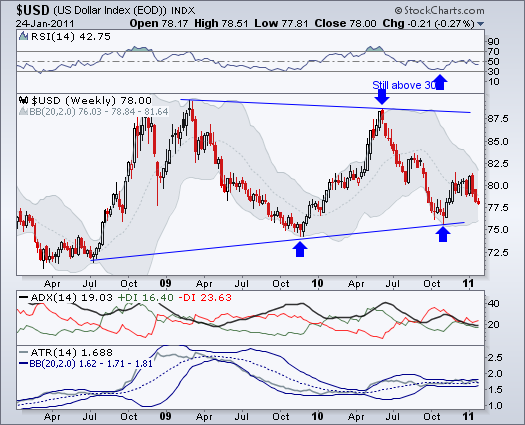
This is no surprise when I say the US dollar is in a long term downtrend, but last month I noticed some strength in the dollar’s technicals which had me thinking that we might be in for a rally in this currency, but the recent action on the RSI monthly/wkly has me thinking otherwise. The inability of this currency on the monthly chart below (click to enlarge) to break above the 60 range is troublesome. Add in the fact that this relative strength index is making lower lows and is now below the 50 range, the bears really are making a strong case that this is a doomed currency.
The weekly chart below (click to enlarge) looks as if it’s heading back down to it’s lower trendline. One area I’ll be watching is whether the RSI goes below the 30 line this time, where it hasn’t been since ’08. If the dollar can’t find buyers that prevent it from going below the 30 line, we may turn up and try to rally to the upper trendline, but for now this is a market to be on the sidelines as I don’t see an edge.
It’s hard to believe when I started coming to Canada that $1.00 US dollar was worth nearly $1.50 Canadian loonies. I remember how cheap it was to go shopping or grab dinner…those days are long gone with the 2 currencies at par and the miserable HST Tax that British Columbia so wrongly enacted on it’s people, tacking on 13%. I have to laugh when economist say that inflation is tame.
Source: www.markets.financial markets.com

Euro Strong Despite Rising Credit Risk Levels in Eurozone

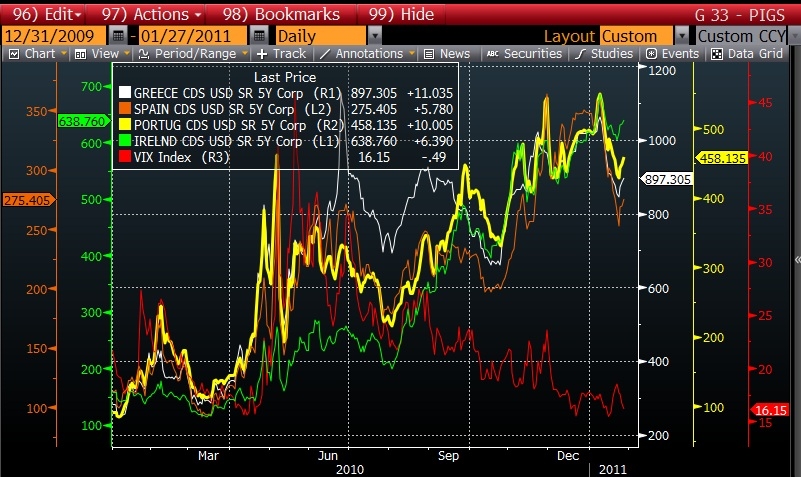
If you watch world equity markets, volatility, interest rates, consumer confidence and currencies, you would be led to believe that the eurozone crisis is behind us. In reality, the eurozone still has a strong contingency of countries with credit default spread levels that are only held by what we consider "junk" bonds. A spread of 639 bps for Ireland implies a 5-year default probability of 43%!

Credit spreads of 600 are unsustainable for continuous government funding. We witnessed a small decline in credit risk levels in the beginning of 2011, but now they appear to be creeping back up to their highest historic levels.
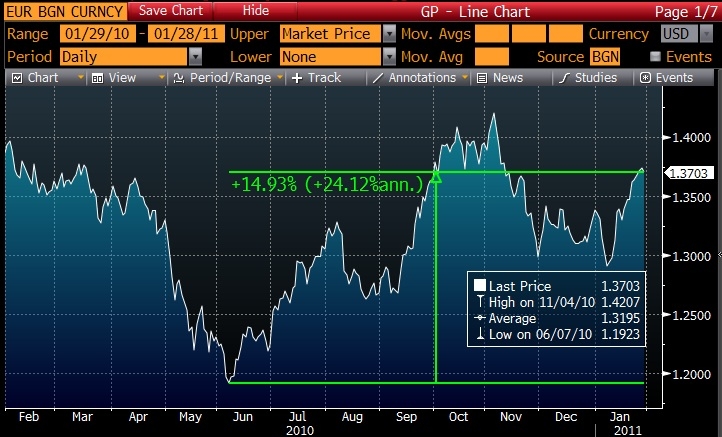
With the eurozone in such distress, we might expect that the Eurodollar would be taking a beating... in fact we see quite the opposite:

Despite lofty levels in eurozone default probabilities, the euro is up 15% from the June lows.
My question to all investors is why the euro deserves respect in today's markets? You might suggest that the euro is the best alternative to the dollar, but I would contend that the eurozone's financial issues and political gridlock trump any hints of credit risk in US sovereign debt. Nothing has been solved in the eurozone and the credit spreads suggest that we have yet to mitigate the problem.
As an investment strategy you might consider shorting the euro versus the currency of your choice. If you are concerned that the euro will continue to rally, then you can play the outlier bet by selling out of the money call options on the CurrencyShares Euro Trust (FXE).

How to Read Currency Quotes

How to Read Currency Quotes

Exchange Traded and Over the Counter Markets


When trading stocks or futures you normally do so via a centralized exchange such as the New York Stock Exchange or the Chicago Mercantile Exchange. In addition to providing a centralized place where all trades are conducted, exchanges such as these also play the key role of acting as the counterparty to all trades. What this means is that while you may be buying for example 100 shares of Google stock at the same time someone else is selling those shares, you do not buy those shares directly from the seller but instead from the exchange.

The fact that the exchange stands on the other side of all trades in exchange traded markets is one of their key advantages as this removes counterparty risk, or the chance that the person who you are trading with will default on their obligations relating to the trade.

A second key advantage of exchange traded markets is that as all trades flow through one central place, the price that is quoted for a particular instrument is always the same regardless of the size or sophistication of the person or entity making the trade. This in theory should create a more level playing field which can be an advantage to the smaller and less sophisticated trader.

Lastly, because all firms that offer exchange traded products must be members and register with the exchange, there is greater regulatory oversight which can make exchange traded markets a much safer place for individuals to trade.

The downside that is often cited about exchange traded markets is cost. As the firms who offer exchange traded products must meet high regulatory requirements to do so, this makes it more costly for them to offer these products, a cost that is inevitably passed along to the end user. Secondly, as all trades in exchange traded products must flow through the exchange this gives these for profit entities immense power when setting things such as exchange fees which can also increase transaction costs for the end user.

Unlike the stock market and the futures market which trade on centralized exchanges, the spot forex market and many debt markets trade in what’s known as the over the counter market. What this means is that there is no centralized place where trades are made, instead the market is made up of all the participants in the market trading among themselves.

The biggest advantage to over the counter markets is that because there is no centralized exchange and little regulation, you have heavy competition between different providers to attract the most traders and trading volume to their firm. This being the case transaction costs are normally lower in over the counter markets when compared to similar products that trade on an exchange.

As there is no centralized exchange the firms that make prices in the instrument that is trading over the counter can make whatever price they want, and the quality of execution varies from firm to firm for the same instrument. While this is less of a problem in liquid markets such as FX where there are multiple price reference sources, it can be a problem in less highly traded instruments.

While the lack of regulation can be seen as an advantage in the above sense it can also be seen as a disadvantage, as the low barriers to entry and lack of heavy oversight also make it easier for firms offering trading to operate in a dishonest or fraudulent way.

Lastly, as there is no centralized exchange the firm that you trade with when you trade in an over the counter market like forex is the counterparty to your trade, so if something happens to that firm you are in danger of loosing not only the trades you have with that firm but also your account balance.

It is for these reasons that there is so much focus among forex traders as to which firm to trade with, with special attention being paid to the financial stability of the firm and the execution that they provide.

As we proceed through this forex trading course we will continue to gain a better understanding of the structure of the market and traders should be well prepared after going through those lessons to make an informed decision for themselves on this issue.

That’s our lesson for today, in our next lesson we are going to look at the structure of the forex market so we can gain a better understanding of who actually controls the market, so we hope to see you then.

Source: http://www.aboutcurrency.com/